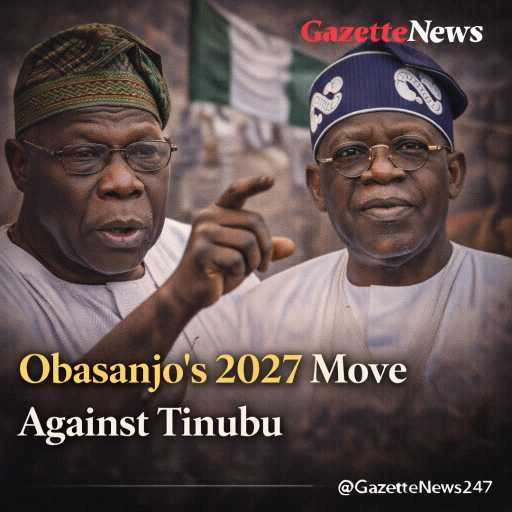
Former President Olusegun Obasanjo is quietly reshaping the 2027 election battlefield, and his latest move signals a major shift in Nigeria’s opposition politics. By backing a proposed Peter Obi–Rabiu Kwankwaso alliance against President Bola Tinubu and sidelining his former vice president, Atiku Abubakar, Obasanjo is not just picking favourites. He is attempting to engineer a coalition powerful enough to unseat the ruling party and redefine Nigeria’s political future.
What Is Really Happening
Behind the scenes, Sunday PUNCH reports that Peter Obi and Rabiu Kwankwaso have set up a joint committee to actualise a single presidential ticket under the African Democratic Congress. The plan, initiated by Obasanjo, is for Obi to run for president and Kwankwaso as his running mate, or vice versa, creating a North–South alliance that can challenge Tinubu’s political base.
Sources inside the ADC say Obasanjo not only encouraged Obi to defect to the party, he also personally connected him with Kwankwaso and key northern power brokers. This is the same Obasanjo who openly campaigned for Obi in 2023 and described him as the candidate with the discipline and character Nigeria needed. His message now is simple. To defeat Tinubu, the opposition must stop dividing itself and present a single, credible alternative.
At the same time, Obasanjo has made it clear that he does not support Atiku’s presidential ambition. That decision is highly symbolic. It shows that Obasanjo believes Atiku no longer represents the future of the opposition and that a new political generation must take the lead.
Why Obasanjo’s Move Is Strategic
This is not a sentimental endorsement. It is a calculated political strategy.
Tinubu’s strength lies in a well-organised party structure and a solid regional base. The opposition has failed in recent elections because it split its votes among multiple strong candidates. By pushing Obi and Kwankwaso into a single ticket, Obasanjo is trying to solve that problem in one move.
Obi brings massive youth support and urban credibility from the South. Kwankwaso brings a strong grassroots network across the North. Together, they form a combination that could seriously threaten Tinubu’s re-election chances if properly managed.
Obasanjo understands that without unity, the opposition will lose again. His intervention is an attempt to force that unity before it is too late.
What This Means for Atiku and the ADC
Atiku’s camp says he is not threatened, but the political reality is different. Being bypassed by Obasanjo weakens Atiku’s influence inside the ADC and sends a signal to power brokers that the future may no longer be with him.
Inside the ADC, the alliance has created tension. Obi’s supporters want the ticket zoned to the South, arguing that it is the best way to defeat Tinubu. Party leaders, however, fear zoning will divide the coalition and hand victory to the APC. This internal battle will shape whether the Obi–Kwankwaso project survives or collapses.
What This Means for Tinubu and 2027
For President Tinubu, Obasanjo’s move is a warning. It shows that the opposition is learning from its mistakes and preparing a serious challenge. If the Obi–Kwankwaso alliance holds, 2027 will not be a routine election. It will be a referendum on Tinubu’s performance, the economy, and security.
Obasanjo’s involvement also gives the project credibility. Love him or hate him, he remains one of the most influential political figures in Nigeria. When he commits to a candidate, elites listen, donors pay attention, and alliances begin to shift.
The Bigger Political Picture
This moment could mark the start of a new opposition era. Instead of personality-driven campaigns, Obasanjo is pushing for a broad coalition built around strategy, geography, and voter maths. If it works, Nigeria could see its most competitive election since 2015.
If it fails, Tinubu will likely walk into a second term with little resistance.
What Obasanjo is doing is not just about 2027. It is about whether Nigeria’s opposition can finally grow up, unite, and become a real alternative government. The outcome will shape Nigeria’s political future for years to come.