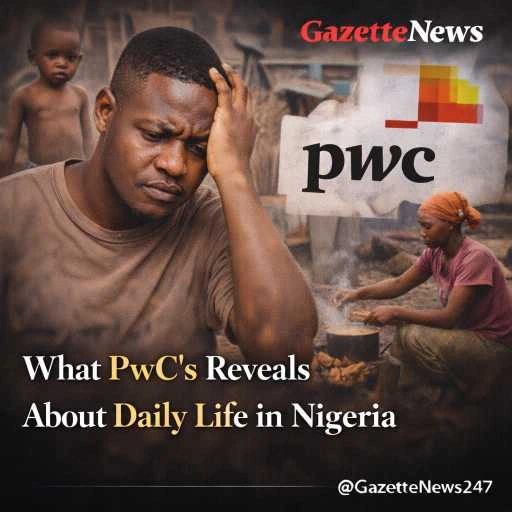
PricewaterhouseCoopers’ latest Nigeria Economic Outlook is not just a report filled with charts and projections. It is a mirror of how millions of Nigerians are living today. When PwC says that about 141 million Nigerians, roughly 62 per cent of the population, could be living in poverty by 2026, it is describing a daily reality already visible in markets, homes, and streets across the country.
What the Report Is Really Saying
PwC warns that despite government claims of economic stabilisation, living conditions are getting worse for ordinary people. Inflation remains high, incomes are weak, and the cost of living keeps rising faster than wages. Even if inflation slows slightly on paper, the report explains that food, transport, and energy costs will stay painfully expensive because of fuel prices, logistics challenges, and the weak naira.
For low-income households, this is devastating. Food alone takes up as much as 70 per cent of total spending. When the price of rice, garri, beans, and cooking oil rises, families do not just cut back. They skip meals, pull children out of school, and sink deeper into debt. Poverty is no longer an abstract concept. It is hunger, unpaid rent, empty pharmacies, and broken dreams.
How This Feels in Everyday Nigerian Life
PwC’s numbers reflect what Nigerians already feel. Salaries do not stretch to the end of the month. Small businesses are closing because they cannot afford fuel, power, or transport. Farmers struggle with insecurity and rising input costs, making food more expensive and scarcer. Civil servants work full time and still cannot afford basic needs.
This is why the report says economic stability is not enough. Stability without growth and jobs means people remain poor, even if inflation charts look better. When households cannot feel improvement, trust in government disappears.
Why Poverty Is Becoming a National Emergency
The report shows that poverty is not only increasing, it is becoming structural. Rising inflation, high interest rates, and naira depreciation are pushing millions below the poverty line every year. PwC had earlier warned that an extra 13 million Nigerians could fall into poverty because of these pressures. That warning is now becoming reality.
The World Bank agrees. It projects that poverty will peak at 62 per cent in 2026, meaning almost two out of every three Nigerians could be living in poverty. This level of hardship weakens the economy itself. People cannot spend, businesses cannot grow, and government revenue falls, creating a vicious cycle that keeps the country stuck.
What This Reveals About Governance
Perhaps the most worrying part of the report is not the numbers, but the response. PwC says political leaders often dismiss or spin these figures instead of confronting them honestly. That gap between leadership and lived reality is why many Nigerians feel abandoned.
Poverty has also become a political tool. During elections, hardship is exploited through vote-buying and manipulation. When people are desperate, democracy becomes fragile. This is not just an economic failure. It is a governance failure.
Why the Future Looks Uncertain
Inflation has already done long-term damage. The removal of fuel subsidies, while defended as necessary, triggered a sharp rise in transport and food prices without enough protection for the poor. Many small businesses collapsed. Jobs were lost. Social protection remained weak.
PwC’s message is clear. Without aggressive job creation, serious investment in agriculture, better logistics, and real social welfare, poverty will keep rising. A country where nearly two-thirds of the population is poor cannot be stable, peaceful, or prosperous.
The Big Picture
What PwC’s poverty report reveals is simple and painful. Nigeria is not just facing an economic slowdown. It is facing a human crisis.
For millions of Nigerians, daily life now means choosing between food and medicine, school fees and rent, dignity and survival. Until policies translate into real relief for households, poverty will remain the strongest story of Nigeria today, louder than any budget speech or reform slogan.