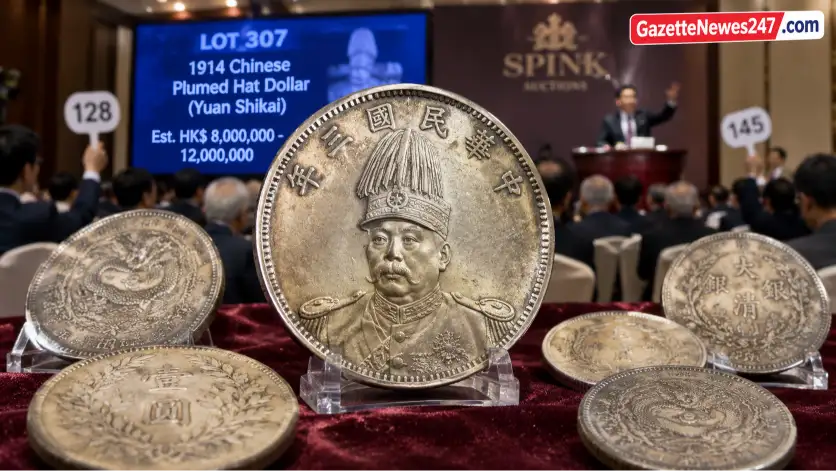
A collection of 12 rare Chinese coins that their former owner believed were worthless has sold for £28,000 at an auction in Kent, United Kingdom, after attracting intense interest from collectors.
The coins, discovered inside an ordinary shoebox, were initially valued at just £100 to £200 by auctioneers at Hansons auction house in Penshurst.
However, competitive bidding between two Chinese buyers pushed the final selling price to £28,000, significantly exceeding the original estimate.
According to the BBC, the auction attracted considerable attention, with applause breaking out when the auctioneer brought the bidding to an end.
How a Shoebox Discovery Became a £28,000 Auction Sale
The collection was brought to Hansons auction house among several items the owner had regarded as worthless possessions.
The 12 coins were reportedly kept together in a shoebox, with their potential historical and financial value initially overlooked.
Auction house officials became suspicious that the collection might contain something valuable after the coins generated significant interest when they appeared in the online auction catalogue.
Collectors, particularly those in China, showed considerable interest in the pieces, eventually leading to a competitive bidding process.
Charles Hanson, who conducted the auction, described the discovery as the ultimate sleeper, expressing surprise at the final amount achieved.
The auction house’s director, Justin Matthews, also explained that the coins had arrived among items the owner considered insignificant.
The Rare 1914 Chinese Silver Dollar That Attracted Attention
<text weight=”medium”> </text>
One of the most notable pieces in the collection was a rare 1914 silver dollar featuring Yuan Shikai, who became the first President of the Republic of China.
The coin is popularly known among collectors as the Plumed Hat dollar because it portrays Yuan wearing an elaborate military hat decorated with plumes.
Its distinctive design and limited production have made it particularly desirable among collectors of Chinese historical coins.
The coin was designed by Italian engraver Luigi Giorgi, who served as chief engraver at the Tientsin Mint in China.
According to the reported historical details, the standard issue had a limited production run of approximately 20,000 pieces.
This restricted mintage, combined with its historical significance, contributes to the coin’s appeal in the international collectors’ market.
Why the Plumed Hat Dollar Is Valuable
The value of rare coins is influenced by several factors, including their age, rarity, historical importance, condition and demand among collectors.
The 1914 Plumed Hat dollar combines several of these characteristics.
First, it dates from an important period in Chinese history, when the country was transitioning from imperial rule to a republic.
Second, its limited production makes surviving examples particularly interesting to collectors.
Third, the portrait of Yuan Shikai gives the coin a distinctive identity that separates it from ordinary silver currency produced during the period.
The strong interest from Chinese buyers at the UK auction demonstrates how historical connections and collector demand can influence the price of rare currency.
However, the reported £28,000 represents the selling price of the entire 12-coin collection, not necessarily the individual value of the Plumed Hat dollar.
Who Was Yuan Shikai?
Yuan Shikai, who lived from 1859 to 1916, was a prominent military and political figure whose influence shaped China’s transition from imperial government to republican rule.
He initially served as a senior military commander during the final years of the Qing Dynasty, China’s last imperial dynasty.
During the 1911 Xinhai Revolution, he played an important role in the political developments that brought an end to centuries of imperial rule.
In 1912, Yuan became President of the Republic of China.
His political career later became controversial when he attempted to restore monarchy and declare himself emperor in 1915.
The move faced strong opposition and eventually collapsed in 1916. Yuan died that same year.
His political legacy and place in China’s modern history have helped make coins bearing his portrait significant to historical collectors.
What the Auction Reveals About the Value of Old Coins
The sale highlights how ordinary-looking possessions can sometimes contain valuable historical objects.
Coins that appear outdated or unfamiliar may attract significant interest if they have unusual designs, limited production numbers or connections to important historical events.
However, not every old coin is valuable. Age alone does not determine its market price.
Collectors and auction specialists generally consider authenticity, condition, rarity, historical background and current demand before estimating the value of a coin.
The Chinese collection demonstrates why people should avoid dismissing unfamiliar old currency without first seeking an expert assessment.
Frequently Asked Questions
1. How much did the rare Chinese coins sell for?
The collection of 12 Chinese coins sold for £28,000 at Hansons auction house in Kent, United Kingdom.
2. Where were the coins discovered?
The coins were found inside a shoebox among items their former owner had considered worthless.
3. What was the initial estimated value?
The collection was initially estimated to sell for between £100 and £200.
4. What is the Plumed Hat dollar?
It is a rare 1914 Chinese silver dollar featuring a portrait of Yuan Shikai wearing a military hat decorated with plumes.
5. Who designed the 1914 Plumed Hat dollar?
The coin was designed by Italian engraver Luigi Giorgi, who served as chief engraver at the Tientsin Mint.
6. Why is the coin sought after by collectors?
Its distinctive portrait, limited production and connection to an important period in Chinese history make it desirable among collectors.
7. Did the Plumed Hat dollar alone sell for £28,000?
No. The reported £28,000 was the final selling price of the entire collection of 12 coins.
Conclusion
The £28,000 auction sale is an example of how valuable historical objects can remain unnoticed for years.
What appeared to be an insignificant collection of old coins turned into a highly competitive auction after specialists and collectors recognised its potential importance.
For the former owner, the discovery in an ordinary shoebox resulted in a sale far beyond the original estimate, demonstrating the unexpected value that rare historical currency can hold.