
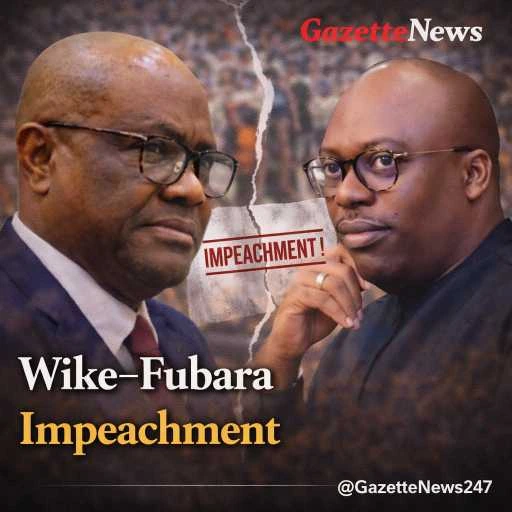
Governor Siminalayi Fubara’s public pledge to maintain peace in Rivers State comes at a tense political moment. Behind his calm words lies a deeper struggle for control in one of Nigeria’s most politically sensitive states. The ongoing impeachment threats and power tussle linked to his fallout with former governor Nyesom Wike reveal how authority in Rivers State is still heavily shaped by godfather politics, loyalty battles, and institutional pressure.
What Fubara Said, and Why It Matters
Speaking at the 2026 Port Harcourt Polo Tournament, Governor Fubara insisted that peace, safety, and governance remain his top priorities. He emphasised that he is still firmly in charge as governor and remains committed to the promises he made to the people of Rivers State. By highlighting the peaceful conduct of the tournament, he was sending a message that the state remains stable despite political noise.
However, his remarks went beyond ceremonial reassurance. His reference to repeated political crises disrupting the polo tournament over three consecutive years was a subtle acknowledgement that Rivers State has been trapped in a cycle of political instability. His comment about receiving a “love letter” in 2026 was widely interpreted as a veiled reference to impeachment threats and political pressure from opposing forces.
The Power Struggle Beneath the Surface
The crisis in Rivers State is not simply about policy differences or governance style. It is about power, control, and who truly runs the state. Since taking office, Fubara has faced resistance from political actors loyal to his predecessor, Nyesom Wike. While Wike no longer holds the governorship, his influence within the political structure of the state remains strong.
The impeachment threats against Fubara are widely seen as a tool in this larger struggle. They reflect an attempt to weaken the sitting governor and reassert control over state institutions, particularly the legislature. This situation exposes how governors in Nigeria can remain vulnerable long after elections, especially when they fall out with powerful political benefactors.
What This Says About Governance in Rivers State
Fubara’s insistence on peace highlights a difficult balancing act. On one hand, he must project authority and stability to residents, investors, and the international community. On the other, he must navigate a political environment where loyalty often outweighs institutions and where governance can be overshadowed by power plays.
The fact that political crises continue to surface during major public events shows how deeply entrenched these conflicts are. Even when government functions continue and public safety is maintained, political tension creates uncertainty that affects investor confidence and long-term planning.
Why the Impeachment Talk Is So Significant
Impeachment threats are not just legal processes. In Rivers State, they are political weapons. The recurring nature of these threats suggests that impeachment is being used less as a constitutional safeguard and more as leverage in an internal power struggle.
Fubara’s response, choosing restraint and public reassurance instead of confrontation, suggests he understands the risks of escalation. His strategy appears to be maintaining public calm while allowing legal and political processes to play out behind the scenes.
The Bigger Lesson About Power in Rivers State
The Wike–Fubara crisis reveals a hard truth about Nigerian politics at the state level. Power does not always transfer cleanly after elections. Former leaders can continue to wield influence, and new governors often spend their early years fighting to assert independence.
Rivers State remains calm on the surface, but the political tension underneath shows how fragile governance can be when institutions are caught between loyalty and law. Whether Fubara survives this storm will depend not just on public support, but on his ability to consolidate authority without plunging the state into deeper political conflict.
For now, his message is clear. Governance will continue, peace will be protected, and Rivers State will not be allowed to descend into chaos. Whether that message holds will define the next chapter of power in the state.