
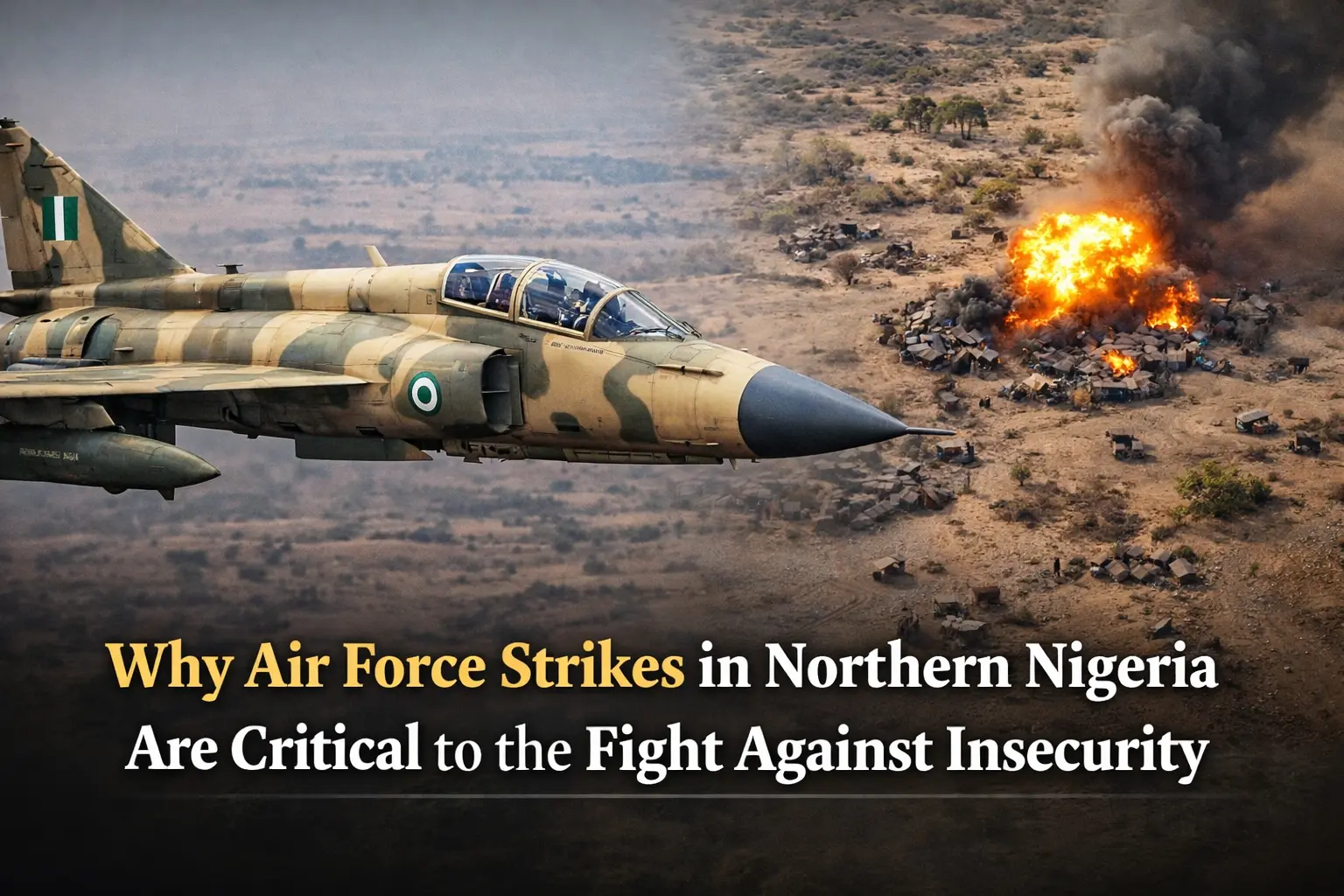
Air Force strikes have become a key tool in Nigeria’s battle against insecurity in the North. As terrorist groups adapt and spread across difficult terrain, aerial operations now play a decisive role in protecting civilians, disrupting armed groups, and supporting ground troops.
What Is Happening
Northern Nigeria continues to face threats from insurgents, bandits, and armed criminal networks. These groups operate across forests, border regions, and rural communities where access by road is limited.
In response, the Nigerian Air Force has intensified air operations to target hideouts, supply routes, and command centers used by violent groups.
These strikes are designed to weaken attackers before they reach towns and villages.
Why Air Power Matters in the North
Northern Nigeria’s geography gives armed groups an advantage. Dense forests, vast savannahs, and porous borders make surveillance and pursuit difficult.
Air Force strikes change that balance.
From the air, security forces can monitor movement, identify threats early, and respond quickly. This limits the ability of insurgents to regroup, move freely, or launch large-scale attacks.
Cutting Off Terrorist Strongholds
Many violent groups rely on remote camps hidden in forests and ungoverned spaces. These locations are often hard for ground troops to access without heavy risk.
Precision air strikes allow the military to hit these strongholds directly. Destroying camps, weapons caches, and logistics hubs reduces the operational strength of groups such as Boko Haram and other armed factions.
This forces them into smaller, weaker units.
Supporting Ground Troops and Civilians
Air operations are not carried out in isolation. They support soldiers on the ground by clearing paths, providing cover, and preventing ambushes.
When troops advance after air strikes, they face less resistance. This improves mission success and reduces casualties.
For civilians, early air intervention can stop attacks before communities are overrun, especially in remote villages.
Speed and Deterrence
One major advantage of air power is speed.
Jets and surveillance aircraft can reach threatened areas within minutes. This rapid response is critical when intelligence suggests an imminent attack.
Repeated air operations also act as a deterrent. Armed groups know they are being watched and can be struck at any time, limiting their confidence and movement.
Addressing Cross-Border Threats
Northern Nigeria shares long borders with several countries. Armed groups often move across these borders to evade capture.
Air surveillance helps track these movements and disrupt cross-border operations. It also strengthens regional security efforts by limiting safe havens near Nigeria’s borders.
Concerns and Accountability
While air strikes are effective, they require careful intelligence and coordination. Authorities stress the importance of avoiding civilian harm and ensuring operations follow strict rules of engagement.
Calls for transparency and accurate targeting remain central to maintaining public trust and long-term success.
Why This Strategy Is Necessary
Nigeria’s insecurity is complex and cannot be solved by air power alone. Economic reform, intelligence sharing, and community engagement remain essential.
However, without strong air support, ground operations would face greater risks and higher casualties.
Air Force strikes give Nigeria the upper hand in a conflict where speed, visibility, and reach are critical.
The Bigger Picture
Air operations are not a shortcut to peace, but they are a crucial pillar of Nigeria’s security strategy.
As long as armed groups exploit terrain and mobility, air power will remain essential in protecting lives and restoring stability in Northern Nigeria.