

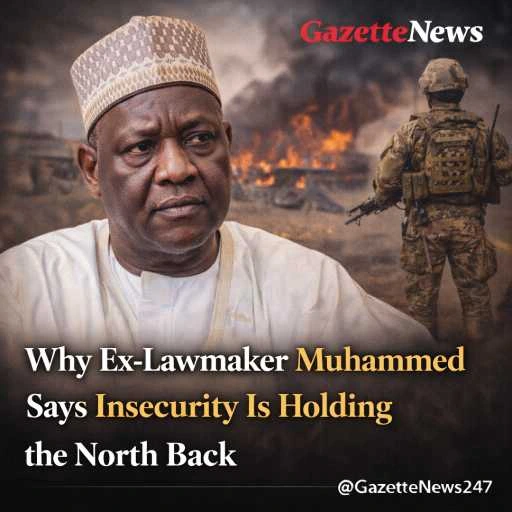
Zakari Muhammed’s warning about insecurity in northern Nigeria is not just another political complaint. It is a blunt diagnosis of why the region is struggling to move forward and why many northerners feel trapped in a cycle of fear, poverty, and political neglect. Speaking as both a former federal lawmaker and a criminologist, Muhammed argues that insecurity is no longer a side issue. It has become the single biggest barrier to development in the North.
Why He Says Insecurity Has Become Worse
Muhammed explains that crime in Nigeria has evolved from petty theft into something far more dangerous. Armed robbery after the civil war gave way to banditry, kidnapping for ransom, and terrorism. What began as isolated criminal activity has turned into organised networks that control territory, recruit young people, and cripple entire communities.
According to him, three major failures are driving this crisis. The first is education. Millions of children are out of school, unemployed, and easily recruited into criminal groups. Extremists exploit this gap, using religion and poverty to radicalise young people for economic and political gain. When people lack education and opportunity, insecurity finds fertile ground.
The second is weak political will. Muhammed insists Nigeria has the military strength and technology to defeat bandits and terrorists, but leaders are not fully committed to ending the crisis. He questions why drones are not being used to track and neutralise criminal hideouts and why insecurity seems to persist despite repeated military operations. In his view, insecurity has been “franchised,” with powerful interests benefiting from the chaos, making some people reluctant to end it.
The third is poor regional cooperation. Nigeria’s borders are porous, and instability in neighbouring Sahel countries has made the situation worse. Since those countries stopped sharing intelligence with Nigeria, criminals now move freely across borders. Muhammed believes President Tinubu’s strained relations with neighbouring states have weakened Nigeria’s security and allowed bandit groups to grow stronger.
How Insecurity Is Holding the North Back
Muhammed says insecurity is destroying the North’s future in slow motion. Farmers have abandoned their fields because they fear kidnapping and attacks. Investors avoid the region because it is unsafe. Businesses shut down, jobs disappear, and poverty deepens.
When people cannot farm, trade, or travel safely, the economy collapses from the grassroots. That is why he says insecurity is not just a security problem. It is an economic disaster that is locking the North into underdevelopment.
He also warns that schools have become soft targets. Bandits attack students and teachers, which pushes more children out of education and feeds the same cycle of crime that created the problem in the first place.
Why He Blames Leadership and Appointments
Beyond security operations, Muhammed links the crisis to politics. He says many northerners feel President Tinubu has sidelined them in key appointments, especially in powerful economic and security institutions. According to him, this has created a sense of exclusion and distrust, which is worsening tensions.
He argues that when a region feels ignored, insecurity becomes easier to exploit. People begin to believe that the government does not care about their safety or future, making it harder to build cooperation between citizens and security agencies.
What He Says Must Change
Muhammed believes the solution is not mysterious. Nigeria must enforce compulsory education, invest heavily in technology-driven security, rebuild intelligence cooperation with neighbouring countries, and show real political will to crush criminal networks.
He insists that insecurity persists not because Nigeria is weak, but because leadership has not fully committed to ending it.
Why This Matters for the North’s Future
In Muhammed’s view, the North cannot develop under constant fear. No serious investment, no strong economy, and no stable democracy can survive where bandits rule the countryside and children cannot go to school safely.
That is why he says insecurity is holding the North back more than anything else. Until it is confronted honestly and decisively, the region will remain stuck, and Nigeria will continue to pay the price.