
A missing photograph at a ruling party event has triggered a wider political debate about loyalty, religion, and succession ahead of Nigeria’s 2027 elections.
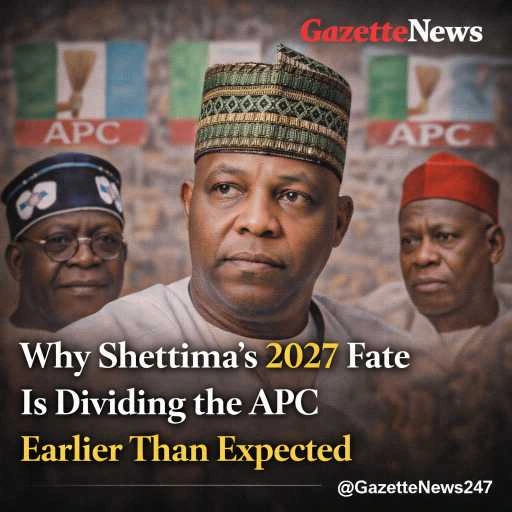
At the North-East Zonal Public Hearing of the All Progressives Congress (APC) in Maiduguri, party leaders gathered under a banner displaying key figures from the zone. President Bola Ahmed Tinubu was there. Governors were there. Senior party officials were there. But Vice President Kashim Shettima, the most prominent APC figure from the North-East and a former Borno governor, was not.
The omission was noticed immediately.
When Abdulkarim Lawan, Speaker of the Borno State House of Assembly, took the podium, he set aside the official agenda and questioned the absence. His remarks drew loud applause from the hall, turning what could have been dismissed as a design error into a political signal. In a region where symbolism matters, the missing image landed heavily.
Why the Omission Matters
This was not the first time Shettima’s image had been excluded from an APC event in the North-East. A similar incident in Gombe State the previous year reportedly led to disruptions. But Maiduguri is Shettima’s political home. Coming at a time when politicians are quietly positioning for 2027, the moment carried extra weight.
Within the APC, speculation has been growing that President Tinubu may consider changing his running mate in the next election cycle. The core of the debate is the future of the Muslim–Muslim ticket, which helped the party win in 2023 but remains controversial in parts of the country. For many observers, the missing banner image appeared to give form to rumours that had previously circulated only in private.
Concerns Inside the APC
Some party figures warn that replacing Shettima would be a risky move. Abayomi Nurain Mumuni, an APC chieftain who worked on the Tinubu/Shettima campaign in 2023, argues that the North currently lacks a Christian candidate with the political structure and regional reach to offset Shettima’s electoral value.
From this perspective, altering a winning ticket could weaken internal cohesion, disrupt governance, and reduce the party’s chances in 2027. Supporters of this view frame the issue less as religion and more as political stability and loyalty.
The North-East Pushback
In the North-East, the reaction has been sharper. Many party members see any plan to drop Shettima as a betrayal of the region’s support for the APC. The APC Youth Parliament echoed this stance, warning that sidelining Shettima could cost the president significant backing in the zone.
Their argument is straightforward: Shettima remains a key political bridge between the North-East and the presidency, and removing him could deepen regional resentment at a sensitive moment.
External Pressure and Religious Balance
Behind the scenes, concerns about foreign scrutiny have also entered the conversation. Statements by former U.S. President Donald Trump on Christian persecution in Nigeria have renewed international attention on the country’s religious balance.
Some APC insiders argue that Nigeria’s security and governance structures already reflect religious diversity, pointing to appointments across defence and intelligence agencies. Others reject the idea that external expectations should influence domestic electoral decisions. The result is a blurred line between internal calculations and outside pressure.
What About the North-Central?
Speculation that the North-Central zone is pushing for a Christian vice-presidential slot has also been publicly denied. The North-Central APC Forum says it is focused on contesting the presidency in 2031, not on replacing Shettima in 2027. The group warned that removing him could shrink the APC’s vote base and give the opposition an advantage.
Public Voices, Mixed Signals
Commentators remain divided. Journalist and former presidential spokesperson Reuben Abati described the rumours as disruptive speculation that could strain relations at the top of government as the 2027 race approaches. Others insist a ticket change is inevitable, arguing that the Muslim–Muslim formula may not hold again.
The Silence That Fuels Debate
Vice President Shettima has said nothing publicly about the banner incident or the rumours surrounding his political future. In Nigerian politics, such silence is rarely neutral. It can signal restraint, calculation, or quiet confidence.
What began as a missing photograph has grown into an early test for the APC. As 2027 draws closer, the party faces a choice: stick with a familiar equation that delivered victory, or risk internal division by changing it. The answer could shape not just the ticket, but the party’s unity in the years ahead.