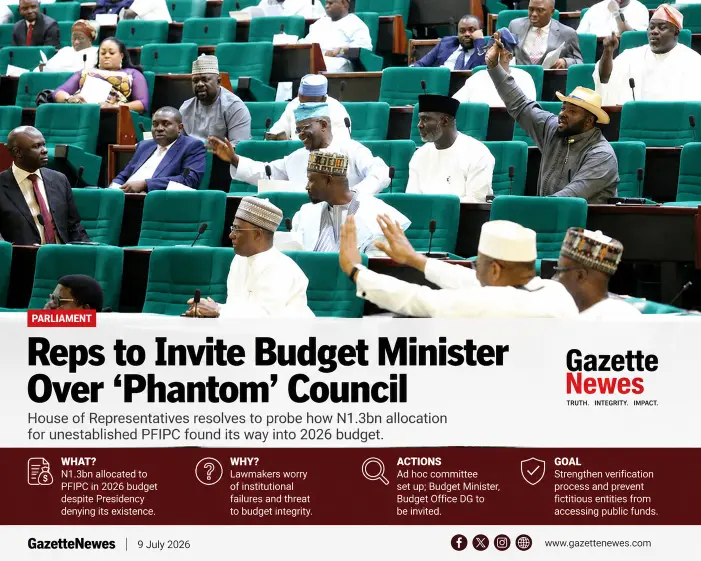
In Nigeria, the House of Representatives has opened an inquiry to investigate the Presidential Foreign Investment Promotion Council (PFIPC) after lawmakers raised questions about what N1.3 billion was allocated to this body within the 2026 budget for the federal government.
The issue has turned into a significant political and accountability issue due to the fact that the presidency has dismissed the PFIPC, and lawmakers are now pondering what a council that is classified as fake could be included in the national approval process.
What has happened?
On Wednesday on Wednesday, on Wednesday, the House of Representatives resolved to invite the Minister of Budget and Economic Planning as well as the Director-General of the Budget Office of the Federation to discuss why they came up with the N1.3bn allotment to the PFIPC was incorporated in the 2026 budget.
The House has stated that it is seeking to follow the budget line from the executive budget proposal to legislative examination.
The motion was made by Hon. Yusuf Gagdi (APC, Plateau) who declared the situation an extremely serious danger to the credibility of Nigeria’s budget and fiscal management.
What is the reason why PFIPC controversial? PFIPC controversial?
The controversy is rooted in the assertion of the PFIPC might not be legally valid despite the fact that it appears to operate in ways that suggest the existence of an official organization.
The Presidency, through its Chief of Staff as well as the president’s spokesperson Bayo Onanuga, slammed it and identified its claimed Director-General Prince Adeniyi Adeyemi, as a “con artist. “
The issue got more complicated due to the fact that the PFIPC was reportedly based out of within the Federal Secretariat in Abuja, worked with several institutions of the government, and allegedly obtained approvals to hire 300 employees, hired office premises, and allegedly established accounts in CBN. Central Bank of Nigeria (CBN) as well as appearing in the Appropriation Act of 2026 with an N1.3 billion budget.
These developments brought up a key concern: How could a organization that was denied by the presidency be able to receive budgetary acknowledgement?
What is the reason why the House looking into it?
The House claims that the probe is not focused solely on criminal charges against those who are linked with the PFIPC. The lawmakers are instead seeking to investigate the financial and institutional shortcomings that enabled the council to obtain the recognition of official authorities.
According to lawmakers that the investigation is essential to ensure credibility of the budget process. examine how an entity without legal support entered into the budget of Congress, identify potential institutional flaws, guarantee public accountability and stop government funds being redirected to institutions that haven’t been authorized by law.
Hon. Yusuf Gagdi also said National Assembly records don’t show any law that established the PFIPC. He said the legislation closest to it to the legislation is called that of the Nigerian Investment Promotion Commission (NIPC) Act.
What measures have the House made?
After the passage of the motion Following the adoption of the motion, House agreed to set up an an ad-hoc committee to determine what happened to the PFIPC budget line was incorporated into within the the budget for 2026..
Lawmakers also voted to request the budget minister as well as Director General of the Budget Office, verify that the ministries, departments and agencies that are listed in the Appropriation 2025 and 2026 Frameworks are supported by enabling laws, instruct that the Office of the Accountant-General of the Federation (OAGF) to ensure that no funds from the public sector are transferred to the PFIPC during the course of the investigation and compel that the Budget Office to submit a certified list of each agency seeking funding in the future bills for appropriation.
What is the significance of the N1.3bn allocation really matter?
It is believed that the N1.3 billion budget is at the heart of the issue because it suggests that the PFIPC was considered to be an official government entity during the budget planning and approval procedure.
Gagdi was concerned that the ease in the entity was able to move through the official channels suggests an overall weakness in the government’s verification systems, rather than an isolated administrative error.
The lawmakers are concerned that if an not-so-established entity is allowed to enter the budget of the nation and other untrue organizations might also be eligible for public funding in the event that stronger verification measures are not put in place.
What was the reason why the Senate not investigate?
In contrast to that of the House of Representatives, the Senate did not decide to initiate the investigation to investigate this PFIPC controversy.
Vice Senate Presidency Senator Barau Jibrin declared that the executive was currently conducting an investigation and suggested that lawmakers wait for the result of this investigation.
The issue is that senator Kawu Sumaila who introduced the motion, suggested that the Senate must continue to investigate the issue on its own because it directly impacts the constitutional authority of the National Assembly to prepare and approve the Federal Budget.
What has the presidency done?
Presidency Bola Ahmed Tinubu instructed his Independent Corrupt Practices and Other Related Offences Commission (ICPC) to conduct an investigation into the activities that are being conducted by the PFIPC and to submit its conclusions by thirty days.
The President has repeatedly stated its position that PFIPC does not an official government agency and has said Adeyemi as an “con artist,” and said there are criminal cases that have been made against the man.
Despite these efforts, opponents, such as ex-Vice President Atiku Abubakar and former Vice President Atiku Abubakar, have claimed the only independent inquiry commission will be able to provide a credible investigation into the situation.
What’s the response of Adeyemi?
Prince Adeniyi Adeyemi, the alleged Director General of the PFIPC has denied that he was defending his council’s allocation of budget.
According to him, he was held in detention in the custody of the police over 23 consecutive days during the time that the budget for 2026 was being drafted and thus, was not able to have prepared or presented the budget in front of in the National Assembly.
He also asked the way an agency today called non-existent would have been included in the nation’s budget.
Which questions are still unanswered?
Several important questions remain unresolved. Investigators must still determine what the PFIPC came into the budget for 2026 or whether the budget came from the executive, or was a result of the legislative process, if any public funds were already released as part of the line of budgets, and who facilitated the council to operate out of government facilities and work through public entities, and what the reasons are for why existing verification systems could not identify the alleged irregularities.
What’s the issue with this for Nigerians?
The PFIPC controversy goes beyond a single dispute over a government council. It’s now a major test of accountability, transparency, and the reliability of Nigeria’s budgetary process.
If they conclude that the PFIPC had budgetary recognition, but not legal basis, the findings could expose major weaknesses in the appropriation system of the country and could lead to tighter checks before that government agencies are included in budgets to come.
The most important thing is the bottom line
The House of Representatives is seeking answers to a key issue: How did a council which the President claims is not in existence receive an N1.3 billion budget in the budget for 2026?
The probe is expected to discover where the budget line was derived and identify any institutional failings and suggest reforms that can stop fictitious organizations from appearing in future budgets of the federal government.