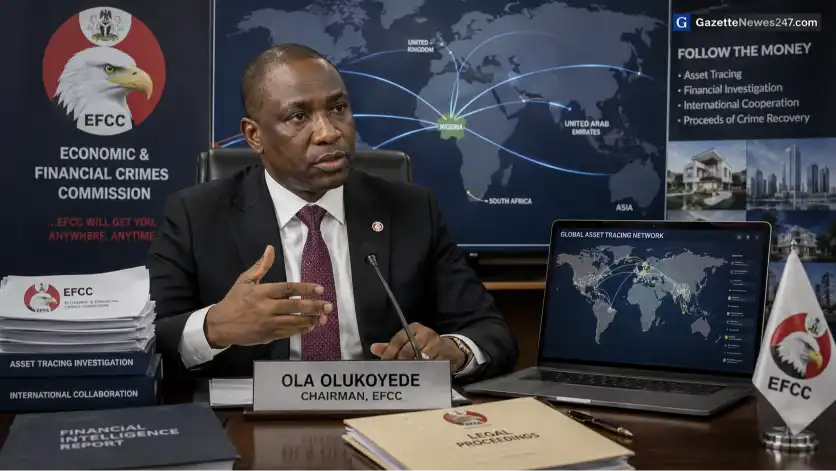
The Economic and Financial Crimes Commission has renewed its call for people with credible information about Nigerian assets allegedly stolen and taken abroad to come forward, saying whistleblowers may receive between 2.5% and 5% of assets successfully recovered as a reward.
The announcement was made by EFCC Chairman Ola Olukoyede during the 43rd International Symposium on Economic Crime in Cambridge, United Kingdom.
The key word, however, is recovery.
The reward is not simply for making an allegation. The information must be useful enough to help authorities trace and recover an asset believed to have been illegally taken from Nigeria.
This article explains what the EFCC announcement means, who may be able to provide information, how the 2.5% to 5% reward could work and what people should know before submitting a report.
What exactly did the EFCC announce?
Olukoyede said people who know the location of Nigerian assets allegedly stolen or moved abroad could receive an incentive of between 2.5% and 5% if their information leads to recovery.
The assets could include money and non-monetary property located outside Nigeria, provided there is credible information that they are linked to proceeds of corruption or other criminal activity.
The EFCC chairman said the incentive was intended to encourage people with valuable intelligence to assist Nigeria’s asset-recovery efforts.
Is the 5% reward a new EFCC programme?
The announcement appears to be a renewed public call for whistleblowers, rather than a completely new whistleblower reward system.
Nigeria has operated a whistleblower policy that provides for financial rewards in cases where information leads to the recovery of public funds or assets. Recent reporting on Olukoyede’s comments indicates that the 2.5% to 5% range follows that existing framework.
This distinction matters because a person should not assume that every tip automatically earns 5%.
The percentage can depend on the applicable reward rules and the value of the successful recovery.
Who can report information to the EFCC?
The EFCC’s appeal was directed broadly at people with credible and actionable information.
Potential information could include details about:
- Bank accounts holding suspected illicit Nigerian funds.
- Foreign properties allegedly purchased with proceeds of corruption.
- Companies or business structures used to conceal ownership.
- Luxury assets linked to suspected proceeds of crime.
- Information that helps investigators identify the country where an asset is located.
- Documents or financial records connecting an asset to Nigeria.
Simply repeating a rumour or making an unsupported accusation may not be enough.
The more useful the information is for investigators, the greater its potential value to an asset-recovery case.
What information could make a whistleblower’s report useful?
A useful report should, where available, provide specific details such as:
- The full name of the person connected to the asset.
- The location of the asset.
- The country where it is held.
- Bank or company details.
- Property addresses.
- Documents supporting the claim.
- How the asset was allegedly acquired.
- Information showing a possible connection to Nigeria.
This does not mean a whistleblower must personally investigate a case. Rather, credible information should be detailed enough to give investigators a genuine starting point.
Will the EFCC pay the reward immediately after receiving a tip?
No.
Olukoyede’s statement makes clear that the reward is connected to successful recovery.
The likely process involves:
- Information is provided to the appropriate authorities.
- The information is assessed.
- Investigators attempt to verify and trace the asset.
- Legal procedures may be required in Nigeria and possibly in the foreign country where the asset is located.
- The asset must be successfully recovered before a reward can arise.
Asset recovery can therefore take time, particularly when money or property is located in another country.
Why are assets abroad difficult to recover?
Tracing money outside Nigeria is more complicated than locating an asset within the country.
Investigators may have to:
- Identify the foreign jurisdiction.
- Trace beneficial ownership.
- Obtain banking or property records.
- Work with foreign law-enforcement agencies.
- Secure court orders.
- Establish the alleged criminal origin of the asset.
- Complete forfeiture proceedings.
This is one reason why information from insiders, associates and other knowledgeable individuals can be valuable.
How does non-conviction-based forfeiture work?
Olukoyede also discussed Nigeria’s use of non-conviction-based asset forfeiture.
In simple terms, this legal mechanism can allow authorities to seek the forfeiture of property believed to be proceeds of crime without first waiting for a criminal conviction against an individual.
However, a forfeiture process still involves legal procedures and court action. It should not be understood as meaning that the EFCC can simply seize any property based on an allegation.
According to Olukoyede, this mechanism has been important in some of the commission’s asset-recovery efforts. He compared the approach with systems used in jurisdictions including Australia and Canada.
How much has the EFCC recovered?
The EFCC chairman said the commission had secured the forfeiture of cash and assets worth more than $500 million to the Federal Government within the three years since he assumed office.
He also referred to major asset-recovery cases involving former public officials and other individuals.
Among the examples he cited were 752 housing units linked to former Central Bank of Nigeria Governor Godwin Emefiele and an investigation involving former Attorney-General and Minister of Justice Abubakar Malami, in which Olukoyede said 48 properties had been forfeited out of 57 properties traced during the investigation.
What should whistleblowers be careful about?
Anyone considering making a report should avoid:
- Inventing allegations.
- Submitting false documents.
- Altering evidence.
- Publicly exposing sensitive information unnecessarily.
- Making defamatory accusations.
- Attempting to illegally obtain bank records or other restricted documents.
People should provide information they genuinely possess and allow the appropriate authorities to conduct the investigation.
A reward should also not be treated as guaranteed merely because information has been submitted.
Can a person become a millionaire from the reward?
It is possible in theory because the reward is calculated as a percentage of assets successfully recovered.
For example:
- 2.5% of ₦100 million would be ₦2.5 million.
- 5% of ₦100 million would be ₦5 million.
- Larger recoveries could produce much larger potential rewards.
However, these are only illustrations. The actual amount would depend on the applicable reward structure, the value recovered and whether the whistleblower qualifies for payment.
What this means for Nigerians and the diaspora
The EFCC’s announcement is especially significant because Olukoyede appealed for information from people anywhere in the world.
Nigerians living abroad, former associates of public officials, employees of foreign companies, financial professionals and others may possess information that could help investigators locate assets allegedly moved outside Nigeria.
For the government, the bigger objective is to recover public wealth that may have been moved beyond Nigeria’s borders.
For potential whistleblowers, the announcement creates a financial incentive to provide credible information — but only information that can genuinely contribute to a successful recovery.
Frequently Asked Questions
Does the EFCC pay 5% for every tip?
No. The reward is linked to credible information that leads to successful asset recovery.
Is the reward exactly 5%?
No. Olukoyede referred to a range of 2.5% to 5%.
Must the assets be outside Nigeria?
The latest appeal focused specifically on Nigerian assets allegedly taken or hidden abroad.
Can someone report property instead of money?
Yes. Olukoyede referred to both monetary and non-monetary assets.
Will the EFCC investigate immediately?
The information would first need to be assessed and investigated. International asset recovery can involve lengthy legal and investigative processes.
Can the whistleblower’s identity be kept confidential?
The recent announcement highlighted the importance of whistleblower protection, but anyone planning to report should carefully follow official reporting procedures and confirm the protections available in their specific case.
Conclusion
The most important part of the EFCC’s announcement is not simply the headline figure of 5%.
It is the attempt to turn people with genuine knowledge of Nigerian assets abroad into potential sources of intelligence for international asset recovery.
But a whistleblower must have more than a suspicion. The information must be credible and useful, and the reward is tied to assets that are ultimately recovered.
For anyone who believes they possess genuine information, the safest approach is to verify the current official EFCC reporting channels before sharing sensitive evidence or personal details.