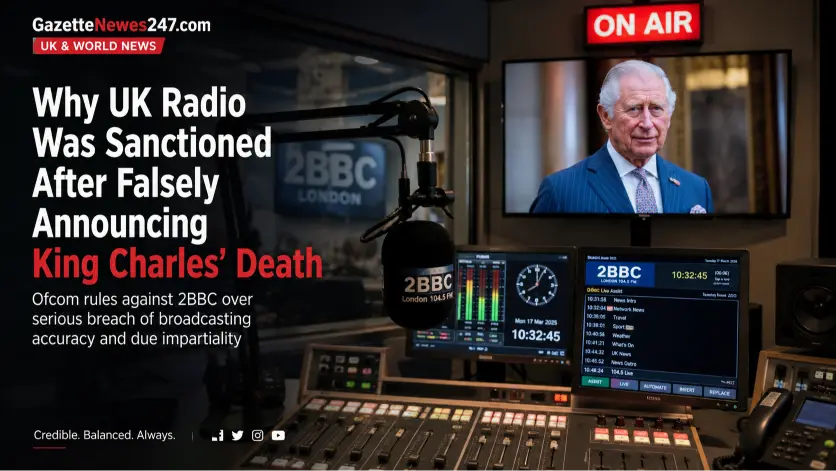
A UK radio station has been found to have breached broadcasting rules after it accidentally announced that King Charles III had died, even though the monarch was alive.
The incident involved Radio Caroline, a former pirate radio station that now mainly broadcasts rock music. In May 2026, the station unexpectedly aired a message announcing the supposed death of the King, followed by the British national anthem and about 16 minutes of silence.
The announcement was not based on a real event. Instead, it happened after a member of staff accidentally accessed and played pre-recorded audio that had been prepared for use when the monarch eventually dies.
The UK’s broadcasting regulator, Ofcom, investigated the incident after receiving two complaints and concluded that the station had breached two of its broadcasting rules.
What Happened at Radio Caroline?
The incident occurred while Radio Caroline was broadcasting a programme remotely.
According to Ofcom, a member of staff was carrying out maintenance on the studio computer when they accessed sound files that had been pre-recorded in preparation for the death of King Charles III.
The staff member reportedly played the files “out of curiosity.”
That action interrupted the programme being delivered remotely and caused the pre-recorded material to be broadcast to listeners.
One of the messages stated that normal programming had been suspended as a mark of respect following the supposed death of His Majesty King Charles III.
The message was followed by the national anthem.
The station then remained silent for approximately 16 minutes before its normal programming resumed.
Why Did Listeners Believe the Announcement?
The incident was particularly serious because the broadcast contained several elements that would normally accompany the death of a British monarch.
It was not simply a presenter making an incorrect statement.
Listeners heard an official-sounding announcement, the national anthem and a prolonged period of silence. Together, these elements could make the claim appear genuine.
For someone hearing the broadcast without any additional information, there was little immediate indication that it was an accident.
This is one reason Ofcom treated the incident as a significant broadcasting error rather than an ordinary programming mistake.
Why Did the Station Take So Long to Correct It?
Another important part of the Ofcom ruling concerns what happened after the incorrect material went on air.
The employee who had played the files reportedly realised what had happened, panicked and left the premises.
The presenter, meanwhile, was broadcasting remotely.
Radio Caroline told Ofcom that the presenter would not necessarily know that they had gone off air unless they were monitoring the station’s output through an internet monitor.
The presenter was also not actively monitoring their phone at the time.
As a result, the presenter did not immediately respond to calls from people at the station who had realised that the false announcement had been broadcast.
Ofcom said the presenter eventually apologised around 30 minutes after the messages were initially triggered.
Why Did Ofcom Say Radio Caroline Broke the Rules?
Ofcom identified two separate broadcasting requirements that had been breached.
1. The broadcast was seriously inaccurate
UK broadcasting rules require news reports to be accurate and impartial.
Ofcom described the false announcement of King Charles’ death as a “very significant inaccuracy.”
The problem was not simply that the station made a minor factual mistake. The broadcast announced an event of enormous national and international significance that had not happened.
The death of a British monarch would be a major national event, meaning accuracy in reporting such an event is particularly important.
2. The mistake was not corrected quickly enough
Broadcasters are also expected to acknowledge and correct significant mistakes promptly.
Ofcom said the length of time taken before the error was acknowledged contributed to the second breach.
This means that even though the original broadcast was accidental, the station still had a responsibility to correct the information once the mistake became known.
The case therefore demonstrates an important distinction in broadcasting regulation: an accidental mistake can still create regulatory problems if it is serious and is not corrected appropriately.
Was King Charles Actually Dead?
No.
The broadcast was false.
The incident had nothing to do with an actual death of King Charles III. The material had been prepared in advance for use when the monarch eventually dies and was accidentally played before it was needed.
The incident therefore illustrates how pre-recorded material can become a serious problem when it is incorrectly accessed or broadcast.
Why Did Radio Caroline Have a Recording About the King’s Death?
Preparing material in advance for major events is common in the broadcasting industry.
News organisations often prepare background reports, profiles, archival material and other content about prominent public figures so that they can respond quickly when major events occur.
For a British monarch, broadcasters may prepare extensive material because the death of a reigning monarch would require immediate and sustained coverage.
Such preparation allows a broadcaster to provide accurate background information without having to produce everything from scratch during an unfolding major event.
The issue at Radio Caroline was therefore not necessarily the existence of the recording.
The problem was that the recording was accessible on a studio computer and was accidentally played while normal programming was taking place.
How Did the Station Respond?
Radio Caroline told Ofcom that the staff member responsible for playing the files had been reprimanded and had apologised.
The station also said that the pre-recorded files had subsequently been removed from the studio computer.
These steps were intended to prevent the same material from being accidentally accessed and broadcast again.
The incident also highlighted the importance of procedures for handling highly sensitive pre-recorded content.
What Does This Mean for Radio Stations?
The case provides a wider lesson for broadcasters about the risks involved in handling sensitive material.
Pre-recorded announcements concerning events such as the death of a monarch, major national emergencies or other significant public events can be useful for preparing a newsroom.
However, such files also need to be securely managed.
A mistake involving an ordinary music file may cause little more than an awkward moment.
A mistake involving a prepared announcement about the death of a head of state can have much more serious consequences.
The incident shows why broadcasters need clear procedures covering who can access sensitive recordings, how they are stored and what should happen if the wrong material reaches the audience.
What Should a Broadcaster Do After Making a Major Mistake?
The Radio Caroline case also provides a useful example of what happens when inaccurate information reaches the public.
A broadcaster that discovers a significant error should generally act quickly.
The immediate priorities include:
- Stop the inaccurate material from continuing to air.
- Establish what went wrong.
- Acknowledge the mistake clearly.
- Provide the correct information.
- Make sure the correction reaches the same audience where possible.
- Investigate the cause of the error.
- Put safeguards in place to prevent a repeat.
The timing of the correction can be especially important when the information concerns a major public event.
Why the Incident Matters
The Radio Caroline case may appear unusual, but it highlights a broader issue facing news organisations: the speed of broadcasting must not come at the expense of accuracy.
A false announcement about the death of a major public figure can spread quickly because audiences may immediately share or repeat what they have heard.
In the age of social media, an incorrect radio announcement could potentially reach people far beyond the station’s original audience within minutes.
That makes verification and correction increasingly important.
For listeners and readers, the incident also serves as a reminder that major claims should be confirmed through reliable sources before being accepted as fact.
Frequently Asked Questions
Did Radio Caroline announce King Charles’ death?
Yes. The station accidentally broadcast a pre-recorded announcement stating that King Charles III had died. The announcement was false.
Is King Charles dead?
No. The Radio Caroline broadcast was an accidental transmission of material that had been prepared in advance.
Why did Radio Caroline have a recording announcing the King’s death?
The recording had been prepared in advance for use when the monarch eventually dies. Broadcasters commonly prepare material ahead of major events so they can respond quickly.
What happened after the false announcement?
The national anthem was played and the station broadcast around 16 minutes of silence before normal programming resumed.
Why did Ofcom investigate Radio Caroline?
Ofcom received two complaints about the broadcast and investigated whether the station had breached UK broadcasting rules.
What rules did Radio Caroline breach?
Ofcom said the station breached rules concerning the accuracy of news reports and the prompt correction of significant mistakes.
Was the announcement deliberately fake?
No. According to the information provided to Ofcom, the material was accidentally played after a staff member accessed the pre-recorded files while carrying out maintenance.
What happened to the employee who played the files?
Radio Caroline said the staff member was reprimanded and apologised.
What did the station do with the recordings?
Radio Caroline said the pre-recorded files were removed from the studio computer.
Conclusion
The accidental announcement of King Charles III’s death by Radio Caroline demonstrates how a seemingly simple technical or human error can become a serious broadcasting issue.
The station had prepared material for a major future event, but the files were accidentally played during a normal broadcast. The false announcement was then followed by the national anthem and a period of silence, making the incident particularly convincing to listeners.
Ofcom’s decision focused on two issues: the seriousness of the inaccurate information and the amount of time taken to acknowledge the mistake.
The wider lesson is straightforward. When broadcasters report major events, accuracy matters, but so does the speed and clarity with which mistakes are corrected.
For audiences, the incident is also a reminder to verify extraordinary claims through trusted sources, particularly when they concern events as significant as the death of a head of state.