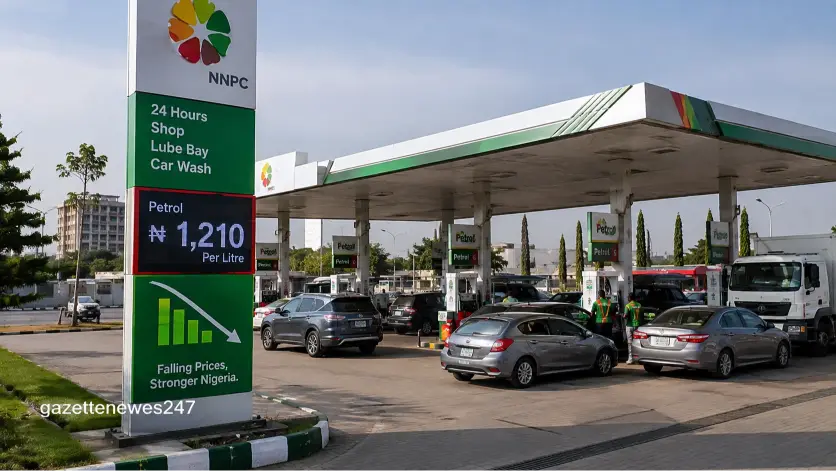
Petrol prices have fallen again at some filling stations across Nigeria, giving motorists another small relief after several rounds of price reductions linked to lower prices from the Dangote Refinery.
The latest adjustment was recorded on Monday, August 10, 2026, with MRS filling stations cutting their petrol price in Abuja and surrounding areas from ₦1,260 to ₦1,210 per litre.
That represents a ₦50 reduction per litre.
Other filling stations have also reduced their prices, although the amount varies from one outlet to another.
For motorists, the development raises an important question: why are petrol prices falling again, and does this mean fuel could become even cheaper?
What Happened to Petrol Prices Again?
A market survey reported on Monday showed that MRS filling stations had reduced the pump price of petrol to ₦1,210 per litre in Abuja and nearby areas.
The previous price was ₦1,260 per litre.
This means motorists buying from affected MRS outlets are now paying ₦50 less for every litre.
Other filling stations have also made downward adjustments.
AA Rano and other outlets along the Kubwa Expressway in Abuja reportedly reduced their prices by about ₦25 per litre, bringing the price to around ₦1,275 per litre.
The reductions are not necessarily the same across every filling station because petrol prices can vary between marketers and locations.
Why Are Filling Stations Reducing Petrol Prices?
The latest reductions are linked to lower prices from the Dangote Refinery.
The refinery announced another reduction in the prices of petrol and Automotive Gas Oil, commonly known as AGO or diesel, during the previous week.
When the cost at the supply level falls, petroleum marketers have an opportunity to reduce their own pump prices.
This is what appears to be happening with MRS and other outlets.
The relationship can be understood simply:
Lower refinery price → lower acquisition cost for marketers → room for lower pump prices.
However, the amount passed on to consumers can differ depending on the individual marketer’s costs, location, transportation expenses and pricing strategy.
Why Is MRS Reducing Its Price by ₦50?
MRS has reduced its petrol price from ₦1,260 to ₦1,210 per litre in Abuja and surrounding areas.
The ₦50 reduction is larger than the ₦25 reduction reported at some other filling stations along the Kubwa Expressway.
This does not necessarily mean every filling station will reduce its price by the same amount.
Petroleum marketers operate under different cost structures, and retail prices can therefore vary even when stations are buying products from the same broader supply market.
For motorists, this means it is worth comparing prices between nearby stations rather than assuming that every outlet has made the same adjustment.
How Much Has Petrol Fallen Recently?
The latest reduction is not the first price adjustment recorded in recent weeks.
Eight days before the latest development, MRS and other filling stations had already reduced their petrol prices by between ₦25 and ₦45 per litre.
That reduction followed an earlier adjustment in the market.
The latest round therefore represents another downward movement rather than an isolated price cut.
For consumers, the pattern is more important than any single ₦25 or ₦50 reduction.
Repeated reductions can gradually lower the cost of transportation and other activities that depend heavily on petrol.
What Does the Latest Reduction Mean for Motorists?
The immediate benefit is straightforward: motorists who buy from stations that have reduced their prices will spend less on petrol.
For example, a motorist buying 20 litres at ₦1,260 per litre would previously have spent:
20 × ₦1,260 = ₦25,200
At the new MRS price of ₦1,210 per litre, the same 20 litres would cost:
20 × ₦1,210 = ₦24,200
That represents a saving of ₦1,000 on 20 litres.
For someone buying 40 litres, the saving would be approximately ₦2,000 at the same ₦50-per-litre reduction.
The actual savings will depend on the filling station and the price available in the motorist’s location.
Could Cheaper Petrol Reduce Transportation Costs?
Potentially, yes.
Petrol is an important input for many transport operators, particularly those using petrol-powered vehicles and generators.
If fuel prices remain lower, some transport operators could experience lower operating costs.
However, a reduction in petrol prices does not automatically mean transport fares will immediately fall.
Transport prices are influenced by several factors, including:
- fuel costs;
- vehicle maintenance;
- spare parts;
- road conditions;
- vehicle financing;
- distance;
- demand;
- and other operating expenses.
Therefore, motorists should not necessarily expect an immediate reduction in fares simply because petrol has become cheaper at some filling stations.
Could Lower Petrol Prices Affect Food Prices?
Fuel prices can influence the cost of moving agricultural produce and other goods around Nigeria.
Trucks, buses and other vehicles used in supply chains require fuel, meaning changes in fuel costs can affect transportation expenses.
If petrol prices continue falling, the reduction could provide some relief to businesses whose operations depend on fuel.
However, food prices are influenced by much more than petrol.
Weather, agricultural production, insecurity, storage, logistics, exchange rates and market demand can all affect the final price consumers pay.
Therefore, cheaper petrol may reduce one part of the cost structure without automatically causing food prices to fall.
Why Don’t All Filling Stations Sell at the Same Price?
One of the most noticeable features of Nigeria’s petrol market is that prices can differ significantly between filling stations.
Several factors can contribute to the difference.
A station may purchase products at a different price from another marketer.
Transportation costs can also vary depending on where the station is located and where its supply comes from.
Operating expenses, competition and the station’s pricing strategy can also affect the final pump price.
This explains why one outlet may sell petrol at ₦1,210 per litre while another nearby station charges around ₦1,275.
Does This Mean Petrol Prices Will Keep Falling?
It is too early to say.
The latest reductions suggest that lower supply prices are being reflected at some retail outlets, but that does not guarantee a continuous decline.
Future pump prices will depend on factors affecting the petroleum market and individual marketers.
For motorists, the important development to watch is whether more filling stations follow MRS and other outlets in reducing their prices.
If additional marketers continue to cut prices, competition could put further pressure on retail prices.
If the reductions stop at the current level, the market could stabilise around the new prices.
What Should Motorists Do?
Motorists do not necessarily need to wait for every filling station to change its price.
The most practical step is to compare prices at nearby outlets.
A difference of ₦25 or ₦50 per litre can become significant for people who buy large quantities of petrol regularly.
For example, a ₦50 difference on 40 litres represents ₦2,000.
Motorists who use fuel frequently may therefore benefit from checking several nearby stations before buying.
However, they should also consider accessibility, queue times and the reliability of the outlet rather than choosing a station based solely on price.
Why the Dangote Refinery Matters to Petrol Prices
The latest reductions also highlight the growing importance of domestic refining in Nigeria’s petroleum market.
When locally refined products are supplied to marketers at lower prices, changes can potentially reach retail filling stations more quickly.
The recent reductions by MRS and other outlets demonstrate how a change at the refinery or supply level can eventually appear at the pump.
For consumers, the key issue is whether this relationship continues to produce lower and more stable prices.
What Happens Next?
The next major question is whether other filling stations will follow the latest reductions.
If more marketers reduce their prices, motorists in additional parts of Nigeria could begin to benefit.
Another important factor will be the pricing decisions of domestic refiners and petroleum marketers.
For now, the latest figures show a continuing downward movement at some outlets, but prices remain different across locations.
Motorists should therefore treat the latest reductions as a market trend rather than a nationwide uniform pump price.
Frequently Asked Questions
What is the new MRS petrol price?
MRS filling stations in Abuja and surrounding areas reportedly reduced petrol from ₦1,260 to ₦1,210 per litre.
How much did MRS reduce petrol?
MRS reduced its reported pump price by ₦50 per litre.
What is the new AA Rano petrol price?
AA Rano and some other filling stations along the Kubwa Expressway reportedly reduced their price by about ₦25 per litre to around ₦1,275 per litre.
Why are petrol prices falling again?
The latest reductions followed another reduction in petrol prices announced by the Dangote Refinery.
Is petrol now ₦1,210 everywhere in Nigeria?
No. The ₦1,210 price reported in the latest market survey applies to affected MRS outlets in Abuja and surrounding areas. Petrol prices can differ between filling stations and locations.
Will petrol become cheaper again?
It is possible, but there is currently no guarantee. Future prices will depend on supply costs, refinery pricing, marketers’ costs and market competition.
Will transport fares fall because petrol is cheaper?
Not necessarily. Fuel is only one component of transport costs. Other expenses can prevent lower petrol prices from immediately translating into lower fares.
Will cheaper petrol reduce food prices?
It could reduce some transportation costs, but food prices depend on many other factors, including production, logistics, insecurity, storage and market conditions.
Conclusion
The latest petrol price reductions provide another measure of relief for Nigerian motorists.
MRS has reportedly reduced its price in Abuja from ₦1,260 to ₦1,210 per litre, while AA Rano and other filling stations along the Kubwa Expressway have also made smaller reductions.
The adjustments follow another reduction in petrol prices announced by the Dangote Refinery.
The immediate impact is clear: motorists buying from affected stations can spend less on fuel.
The bigger question is whether the downward movement will continue and whether more filling stations will pass lower supply costs on to consumers.
For now, motorists should not assume that one price applies nationwide. Petrol prices continue to vary by marketer and location, making it worthwhile to compare nearby filling stations before buying.
If the current trend continues, however, further reductions could provide broader relief for transport operators, businesses and households that depend heavily on petrol.